
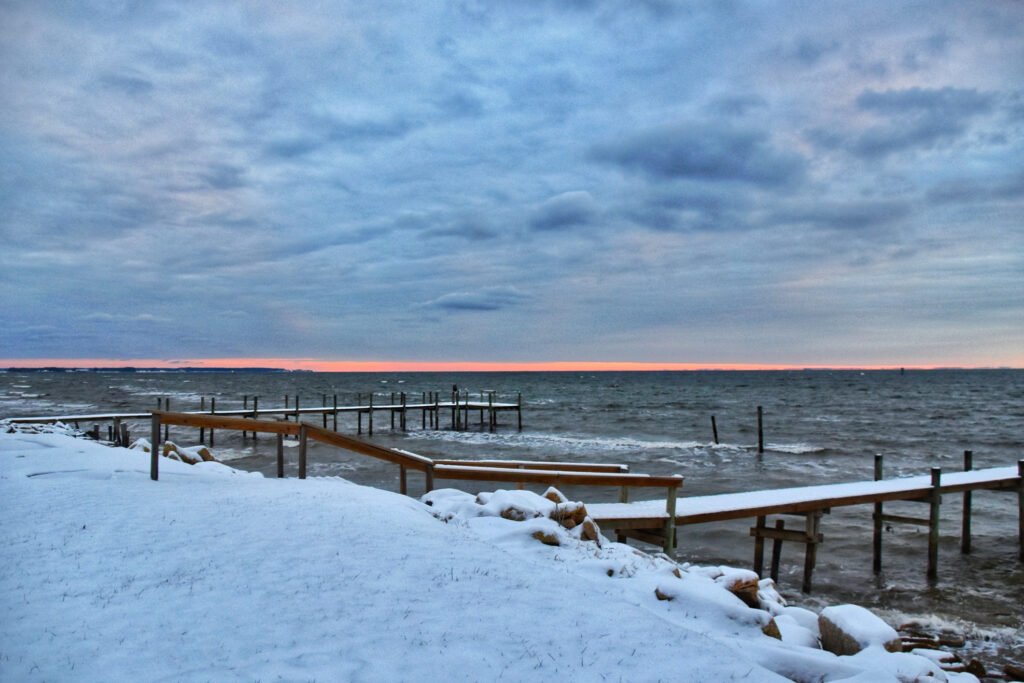
TL;DR
Marine construction does not shut down in winter. Crews keep working, even when conditions are rough, and the real constraint is the tide, not the cold. Winter winds can push water out of creeks and rivers, which limits barge access to some properties, so use the colder months to book a site visit, get a design and quote, and start permitting. That way, your spring pier, dock, bulkhead, or boat lift project is already on the calendar.
Winter has a reputation as the off-season for marine construction. It is not. Waterfront homeowners across Anne Arundel County looking for a dock builder in the colder months often assume the work has stopped. Crews keep working straight through the colder months. The real constraint is not the cold.
It’s the tide.
Does Marine Construction Stop in the Winter?
Winter dock construction and other marine work continue through the colder months. Some days are brutal on a crew, with wind, cold water, and short daylight, but the work keeps moving. At Anchored Marine Construction, crews work 60-hour weeks year-round, with no winter break.
The biggest change throughout the winter is the schedule. Winter is not a dead season for marine work. It does, however, require a scheduling conversation, and that starts with how a crew can physically reach your property.
Winter arrives with an upside for marine construction, though. The Maryland Department of the Environment prefers that in-water work occurs in the colder months, when submerged aquatic vegetation is not present.
How Winter Tides Affects Barge Access
Strong winter winds can push water out of local creeks and rivers, leaving the tide lower than normal. This matters because projects like pier and bulkhead replacement and new construction, rock revetment, and demolition work depend on a barge to carry equipment and materials to the work site, and a barge needs enough water to float into position. Boat lift crews work from purpose-built flat deck pontoon boats instead.
When the tide is blown out, a barge may not be able to reach certain properties. Access varies from one property to the next, which is why each site is individually assessed.
All that said, low winter tides do not cancel a project. A job that needs barge access is either sequenced into the proper tidal window or booked for spring.
Water depth is the real limit, and at Anchored Marine Construction, our crews have learned to work around most depth issues. Once the water has blown out, we can sometimes ramp the excavator off the barge and work from harder, sandier bottoms. Other projects wait for the tides to return in April, May, or June. Either way, low winter tides do not cancel a project. We sequence jobs that need barge access into the proper tidal window or book them for spring, and we plan ahead of time.
What Work Can Still Be Done in the Colder Months
Much of what makes a project successful happens long before a single piling is driven. That groundwork does not hinge on the tide:
- Site visit: We walk your waterfront, look at the existing structure and shoreline, and talk through what you need it to do.
- Design and quote: A few days after the site visit, we discuss your options. A few days after that, you receive a design and a quote, with permitting scheduled and priced separately.
- Permitting: Once the contract is signed, permitting begins.
Jobs that do not rely on a barge are also less affected by low winter tides. In practice, that means repairs and boat lift work can keep moving through winter.
Planning Your Spring Dock, Pier, or Bulkhead Project Now
Permits take time, and barge access hinges on the tide. When a project requires permitting, expect roughly four months to secure permits from the Maryland Department of the Environment and Anne Arundel County. Spring also fills up early, because customers want their projects completed by the start of the boating season.
The earlier you start the process, the more flexibility there is to match your project to the ideal window. Winter is a good time to start the planning and permitting for any of these:
- Pier and dock construction or repair
- Bulkhead repair or replacement
- Boat lift installation or repair
If a bulkhead has started leaning or pushing outward, don’t delay. A site visit long before spring can tell you whether the work can move forward in winter or should be sequenced for a later date. For full bulkhead replacements and rock revetments, spring and fall are the best windows. We want tides a little lower than usual, but not completely blown out.
Reach out to our team this winter, and your spring project will already be on the calendar.
***
FAQs
Do marine construction companies work in the winter?
Without stop. Some projects wait for the right tide, but winter is not a shutdown season. At Anchored Marine Construction, crews work 60-hour weeks year-round.
Why can’t a barge reach my property in the winter?
Winter winds can push water out of creeks and rivers, lowering the tide. A barge needs enough water to float into position, so shallow spots may not be reachable until the water returns. Access depends on the specific property, which is why we look at each site individually. Once the water has blown out, the Anchored Marine crew can sometimes ramp the excavator off the barge and work from harder, sandier bottoms.
Is winter a bad time to replace a bulkhead?
Winter is not the ideal time. Bulkhead replacements are best scheduled in spring or fall, when tides are a little lower than usual but not completely blown out. A failing wall should not wait, though. Repairs do not require a barge and can move forward in winter.
When should I schedule a spring dock or pier project?
As early as you can, ideally during the winter. A site visit, design, quote, and permitting all come before construction, and permitting alone can take one to four months. Starting early means your project is ready to schedule when conditions allow.
Do you service all of Anne Arundel County year-round?
Yes. Anchored Marine is a family-owned and operated dock builder serving waterfront properties throughout Anne Arundel County, and crews keep working through the winter. Winter scheduling depends mostly on tides and site access.